
 Share
Share
 Share
Share
Before a major peak event, the question most organizations ask is some version of: can our systems handle the load?
It’s a reasonable question. Teams run load tests, provision capacity, and push thresholds to their limits. By the time peak arrives, there’s a level of confidence that the infrastructure will hold.
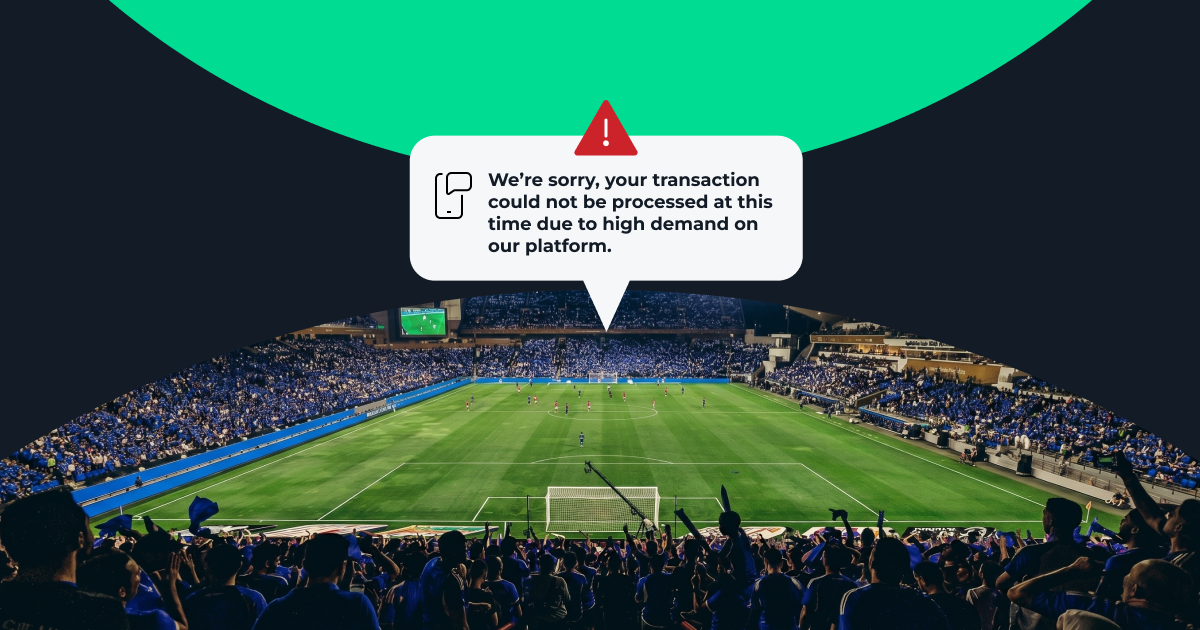
Then the event arrives. Traffic surges. Not in the smooth, predictable curve of a test environment, but in sharp, uneven spikes tied to real-world triggers. And what starts to fail isn’t capacity. It’s consistency.
Table of Contents
Why capacity and consistency are different problems
Capacity is a threshold question: how much can this system absorb before it fails? Consistency is a behavioral question: how does this system perform as conditions change?
During peak demand, it’s the behavioral question that matters most, because teams aren’t operating in a controlled environment. They’re managing rapid shifts in traffic patterns, increased dependency between systems, and compressed response windows if something goes wrong.
For fraud and risk teams, inconsistency means delayed visibility—by the time signals surface, the window to intervene has closed. For product teams, it means features that behave differently under load than they do in testing, creating user-facing issues that are hard to diagnose in real time. For customer engagement and marketing teams, it means campaigns and journeys that degrade unpredictably, undermining experiences that were months in the making.
In each case, the infrastructure didn’t fail in the traditional sense. It simply stopped being reliable at the exact moment reliability mattered most.
The hidden cost of manual intervention at peak
When infrastructure isn’t designed for predictable scale, teams compensate with people that monitor dashboards around the clock. Fraud analysts manually review queues that automation should be handling. Operations teams make real-time routing decisions that should be happening automatically.
This approach has a ceiling. At the scale that mega global events generate, manual intervention can’t keep pace. Response windows shrink to minutes. The cost of a wrong call, or a slow one, compounds quickly across millions of concurrent sessions. Infrastructure that requires heroics to perform at peak isn’t peak-ready. It’s peak-dependent on people.
What predictable scale actually requires
Peak-ready infrastructure is designed around a different set of requirements than simply provisioning for maximum load. Three properties distinguish it:
Automatic scaling that maintains performance consistency: Not just spinning up additional capacity, but ensuring that system behavior, including latency, delivery rates, response times, remains within expected bounds as demand changes. Scale events should be invisible to end users and to the teams depending on those systems.
Real-time visibility across the full infrastructure stack: Teams shouldn’t be discovering degradation through support tickets or customer complaints. Shared performance signals, surfaced in real time, allow teams to act on conditions rather than react to consequences.
Predefined responses to threshold events: When conditions change, such as traffic spikes, a channel degrades, fraud velocity increases, the system should respond automatically according to logic that was designed in advance. Not improvised under pressure.
Together, these properties shift the operating model from reactive to predictive. They reduce reliance on manual intervention and enable teams to operate with confidence rather than vigilance.
Readiness takeaway
True scalability isn’t measured by how much your systems can handle. It’s measured by how consistently they behave as demand changes. If your infrastructure requires manual oversight to stay reliable at peak, the
Are you ready for peak customer demand during mega global events? Evaluate your authentication, messaging, and engagement infrastructure. ➡️ Review your readiness