
 Share
Share
 Share
Share
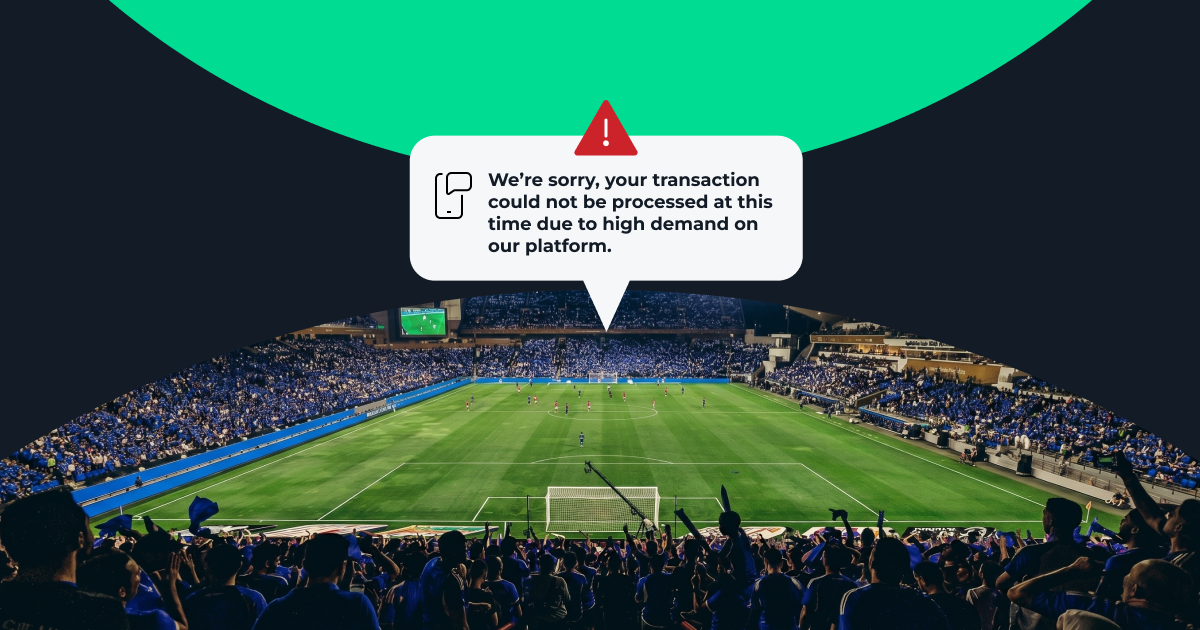
Picture the moment a customer completes a high-stakes transaction during a major global event. They’ve just booked flights for an international trip, purchased limited-edition merchandise, or placed a bet on the outcome of a match that billions of people are watching.
Now picture what happens next: nothing. No confirmation message. No authentication prompt. No update. Just silence—while they refresh, wonder, and start to doubt.
That gap between action and confirmation is where trust erodes. And during mega global events, it happens at a scale that turns a communications infrastructure problem into a brand problem.
Customer communications aren’t just a supporting function during peak demand. They’re core infrastructure. Here’s what happens when they’re not treated that way.
Table of Contents
What communication failure actually costs you
Communication failures during peak demand rarely announce themselves as infrastructure failures. Instead, they surface as support ticket volume that triples overnight, authentication messages that arrive too late for a time-sensitive transaction, and notifications that never reach customers in certain regions because routing couldn’t adapt to conditions.
For fraud teams, delayed or missing messages create dangerous blind spots, customers who can’t complete verification abandon sessions, but so do fraudsters who’ve learned to exploit the gap. For product teams, inconsistent delivery introduces friction at exactly the moments where the experience should feel seamless. For marketing and engagement teams, it erodes the credibility of campaigns that took months to build.
The compounding effect is what makes this particularly damaging during high-visibility moments: a communications failure at peak isn’t a footnote. It’s the story.
Recognition is as important as delivery
There’s a second dimension to communication infrastructure that organizations often overlook: whether customers actually trust the messages they receive.
Mega global events create ideal conditions for fraud and impersonation. Bad actors know that consumers are receiving a high volume of messages from brands, including promotions, confirmations, alerts, and offers, and that the increased noise makes it harder to distinguish legitimate communications from spoofed ones.
Verified messaging changes that equation. When customers can immediately identify that a message is genuinely from your brand, not just via sender name, but through verifiable identity signals, engagement rates improve and phishing risk drops. Channels like RCS and WhatsApp Business Messaging are purpose-built for this: richer, branded experiences that customers recognize and trust at a glance.
Delivery without recognition is just noise. Recognition without delivery is a missed opportunity. Peak readiness requires both.
Designing communications as infrastructure, not afterthought
Organizations that communicate well under pressure don’t improvise during peak moments; they design for them in advance. That requires building communications infrastructure with three properties that most point solutions simply don’t offer:
Global reliability: Messages need to reach customers across regions and carriers with consistent delivery performance—not just in ideal conditions, but when network load is highest and routing conditions are most volatile.
Adaptive routing: When a primary channel experiences degradation, infrastructure should automatically fall back to alternatives without manual intervention. A single API with muti-channel fallback isn’t a convenience feature; it’s a resilience requirement.
Verified sender identity: Customers should be able to trust the source of every message they receive from your brand, regardless of which channel it arrives on. Especially when fraud attempts spike alongside engagement.
When communications are designed as infrastructure rather than treated as an add-on feature, they support authentication, drive engagement, and reduce operational load simultaneously. They become a capability that performs when it matters most, not a system that degrades under pressure.
Readiness takeaway
Customer communications must perform with the same reliability as your core platforms, particularly when volumes surge. If your messaging infrastructure isn’t built to deliver, verify, and adapt at scale, the next mega global event will surface that gap in front of your most engaged customers.
Are you ready for peak customer demand during mega global events? Evaluate your authentication, messaging, and engagement infrastructure. ➡️ Review your readiness